Summary
Nearly every private credit fund describes its loans as secured. The word covers several different legal positions, and the differences decide who gets paid when a loan fails. In New South Wales those positions are recorded on a public register, and the register’s rules are the actual product an investor in a mortgage fund owns.1
| The jargon | What it means in practice |
|---|---|
| Torrens title | The NSW land ownership system. The government’s register is the official record, and what the register says is who owns what. |
| Registered mortgage | A loan recorded on that register against the property. It becomes a legal interest in the land itself, visible to everyone, protected by the system. |
| First / second mortgage | Position in the repayment queue. Registered mortgages rank in the order they were registered, and the first must be paid out in full, including unpaid interest and costs, before the second receives anything. |
| Caveat | A formal notice on the title that freezes most dealings while a claim is sorted out. It is a warning flag. It is not a mortgage and gives no right to be paid from the property. |
| Mortgagee sale | The lender’s statutory right to sell the property after default and proper notice, with legal duties around obtaining market value. |
Sections 01 and 02 build the repayment queue from these pieces. Section 03 prices the difference between first and second position with a worked example, because the extra 4 per cent in the standfirst has an exact cost attached, and it can be calculated.
What this paper does not claim: that second ranking credit is illegitimate. It is a different risk at a different price; our view is only that the two should never be pooled without saying so.
1st
Registered position, every Oxford loan
s42
Real property Act 1900, the core protection
100%
First paid, with arrears and costs, before the second
+4%
The premium this paper prices
Section 01
The register decides.
New South Wales runs land ownership on the Torrens system, which replaced chains of old paper deeds with a single government register more than 160 years ago. The system’s central rule is that a person recorded on the register holds their interest free of most claims that are not also on the register, subject to narrow exceptions such as fraud. Lawyers call this indefeasibility. In practice it means the register is the final word on who holds what against a property.1
A mortgage gets the full benefit of this system only when it is registered. On registration, the lender holds a legal interest in the land, ranked by the date it hit the register. An unregistered loan agreement still binds the borrower personally, and courts can enforce it between the two parties, but it sits outside the system’s protection when other claims compete for the same property.
Plain English · the caveat, honestly described
A caveat is cheap, quick and useful for what it is: a tripwire that stops the title being dealt with while a claim is examined. Marketing material sometimes presents caveat backed lending as a near equivalent of a registered mortgage. It is a warning flag on someone else’s asset, and a fund whose security is mainly caveats holds flags.
The register is also public. Anyone can search a title for a few dollars and see every registered mortgage against it, in order. This matters for investors in mortgage funds: the ranking a fund claims for its loans is independently checkable, loan by loan, and a manager should expect investors to check.
Section 02
The repayment queue, and who runs the sale.
After a default and the required statutory notice, the first registered mortgagee can sell the property. The law imposes duties on how the sale is run, including good faith and proper regard to achieving market value, and within those duties the first mortgagee chooses the agent, the method and the timing.2 Sale proceeds then travel down a fixed queue.
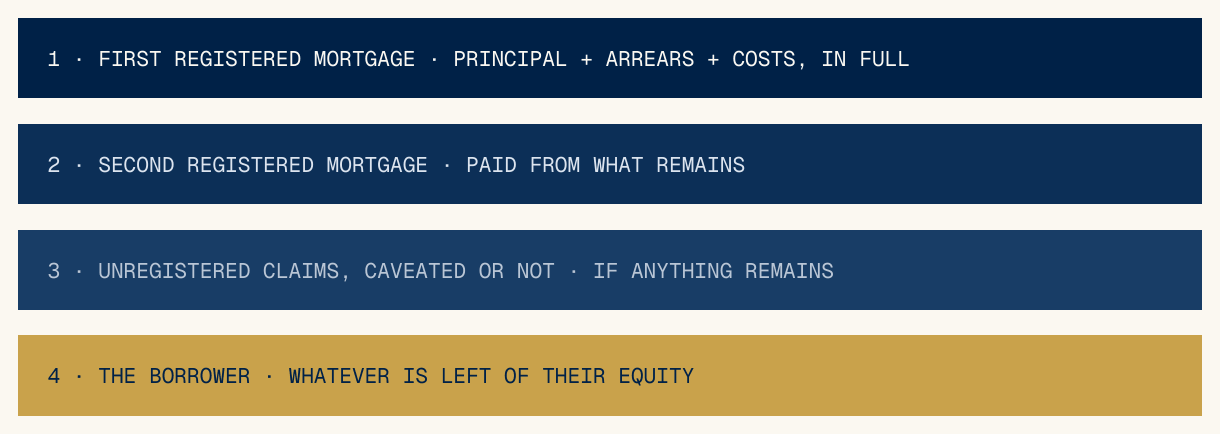
Control of timing is worth dwelling on, because it is the part of second position that surprises people. A second mortgagee can be carried into a sale it would have delayed, at a price that clears the first mortgage in full and leaves the second short. Its main practical remedies are to buy out the first mortgage or to bid at the auction itself, and both require fresh capital at exactly the moment capital is scarce. The first mortgagee also maintains its position actively: loan documents restrict later mortgages without consent, and a diligent first lender monitors the title it sits on throughout the loan.
Section 03
Pricing the extra 4 per cent.
Here is the worked example. Property valued at $100. First mortgage of $65. Second mortgage of $12 behind it, taking total debt to $77. The borrower defaults and the property is sold in a falling market, with the same costs and arrears assumptions as Paper 04. The table runs the sale at three sizes of market fall.
| Market fall | Net sale proceeds | First recovers (needs $71.30) | Second recovers (needs ~$13.30 with arrears) |
|---|---|---|---|
| -10% | $87.75 | $71.30, in full | $13.30, in full |
| -20% | $78.00 | $71.30, in full | $6.70 of $13.30, about half |
| -30% | $68.25 | $68.25 of $71.30, a 4.7% loss | $0.00 |
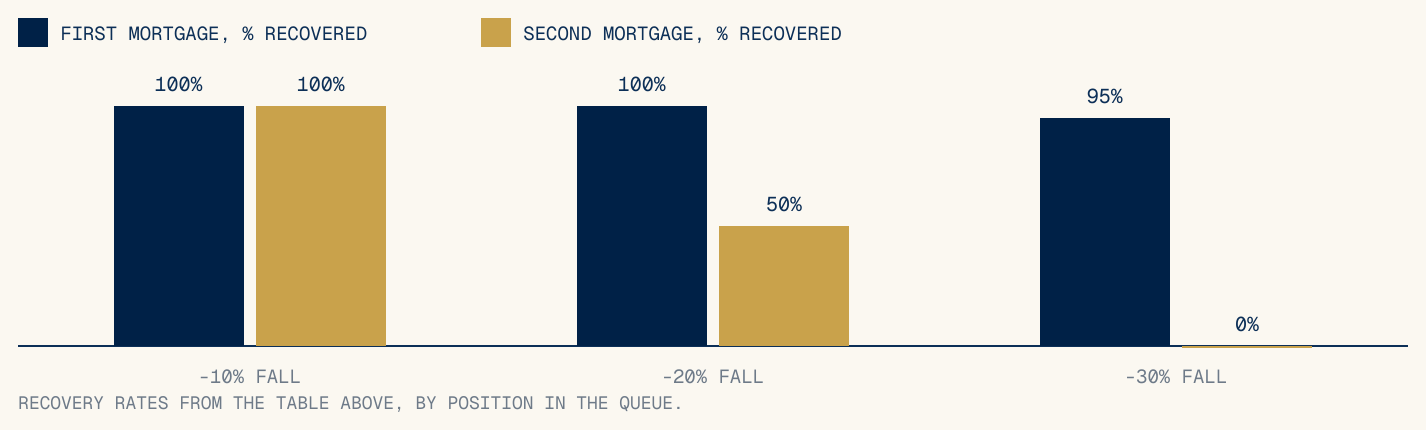
The extra 4 per cent a year is the market’s price for standing second in that queue. Whether the price is adequate is a judgement each investor can make, and second ranking lending, clearly labelled and priced, is a legitimate business. The practice this paper objects to is narrower: pooling first and second mortgages under one blended rate and one word, secured, because the blend cannot be priced by the person whose money it is. A fund should state its ranking mix as a number. Ours is 100 per cent first registered, it is a mandate rule rather than a preference, and it appears in the quarterly disclosure table described in Paper 06 where anyone can check it against the register.
Sources and method.
- Real Property Act 1900 (NSW): the Torrens register, indefeasibility of registered interests including section 42, and priority of registered dealings by order of registration.
- Real Property Act 1900 (NSW) and Conveyancing Act 1919 (NSW): default notice requirements and the mortgagee’s power of sale, with the statutory and general law duties governing its exercise.
Method notes.
This paper is a plain language description of the New South Wales machinery for a wholesale audience and is deliberately simplified. It does not cover old system land, insolvency interactions, priority disputes involving fraud, or the rules on further advances, and the description of the mortgagee’s sale duties summarises statute and case law without reproducing either. Nothing here is legal advice. The Section 03 example uses Paper 04‘s assumptions: selling costs of 2.5 per cent of the price achieved and arrears and enforcement costs taking the first mortgagee’s requirement to $71.30 per $65 lent; the second mortgagee’s requirement of about $13.30 includes its own nine months of arrears at a representative second mortgage rate. Recovery against the borrower personally is excluded. Figures may not sum exactly due to rounding.
Disclosure.
This paper is issued by Oxford Capital Pty Ltd (ACN 700 065 872). Oxford Capital Pty Ltd is the investment manager of the fund and a corporate authorised representative (CAR No. 1323556) of Non Correlated Advisors Pty Ltd ACN 158 314 982, AFSL 430126. It does not hold an Australian Financial Services Licence of its own. The trustee of the fund, and the issuer of units in it, is Non Correlated Capital Pty Ltd ABN 99 143 882 562, AFSL 499882. This document is general information and commentary only. It is not financial product advice, does not take into account any person’s objectives, financial situation or needs, and is not an offer or invitation to acquire any financial product. Any interest in a fund managed by Oxford Capital will be offered only to wholesale or sophisticated investors within the meaning of the Corporations Act 2001 (Cth). Oxford Capital is a lender against Australian property and has an interest in investors considering private credit; readers should weigh this paper accordingly. Figures are drawn from third party sources believed reliable but not independently audited. Past performance is not an indicator of future performance. Nothing here is a statement that any investment is safe or that capital is protected.
OC-RP-05 · August 2026 · Second edition