Summary
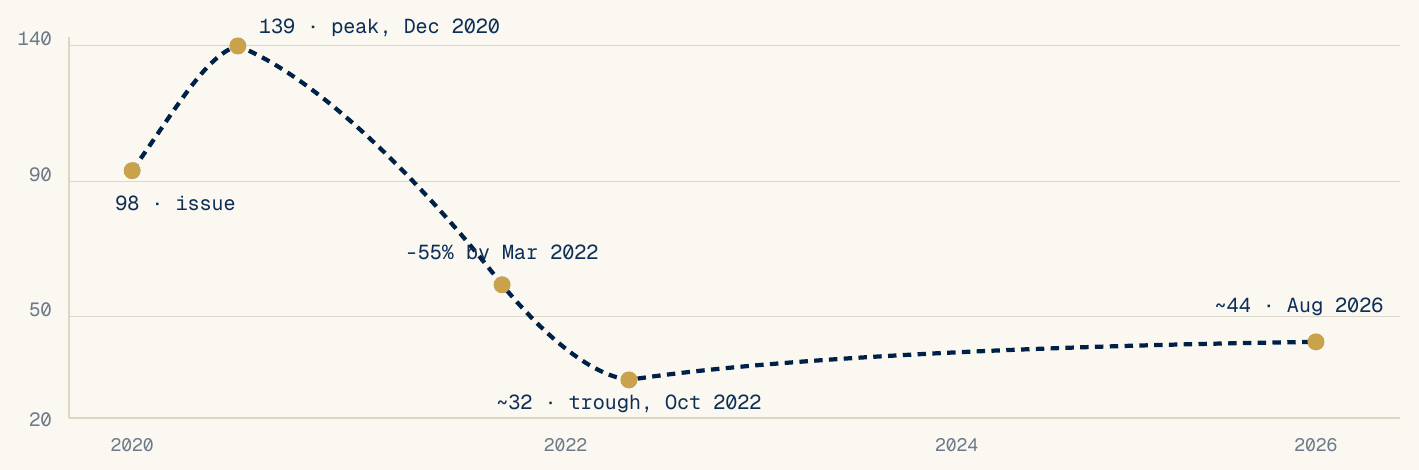
In June 2020 the Republic of Austria issued a bond that repays in the year 2120 and pays interest of 0.85 per cent a year along the way. Austria is rated AA+, one notch below the top rating, and it has made every payment on schedule.1,2 The bond’s price tells a separate story, and the table below holds both stories side by side.
| The borrower’s record since 2020 | The lender’s experience since 2020 |
|---|---|
| Interest payments missed: none | Bought at issue (about 98): worth about 44 today, down 55% |
| Credit rating: AA+ throughout | Bought at the December 2020 peak (about 139): down 68% |
| Defaults, restructures, currency problems: none | Lowest point, October 2022: about 32 |
The gap between the two columns is caused by one thing: interest rates rose. The bond’s 0.85 per cent is fixed until 2120, so when investors could suddenly get 3 per cent elsewhere, nobody would pay full price for a century of 0.85. The price fell until the bond’s return matched the new market rate. Nothing else about the bond changed.3,4
Plain English · interest rate risk
When rates rise, the price of existing fixed rate bonds falls, because their old, lower interest payments become less attractive compared with new bonds. The longer the bond has left to run, the bigger the price move. This is often called duration risk. It applies even when the borrower is completely reliable.
Australia ran a smaller version of the same experiment at the same time. The main Australian bond index, the AusBond Composite, which sits inside the defensive part of most super funds’ balanced options, fell 12.7 per cent from its 2021 peak to its 2022 trough. No borrower in the index failed either.5 Sections 03 and 04 cover the Australian version and what it means for a first mortgage held to its repayment date.
What this paper does not claim: that rates will rise again, or that traded bonds have no place in a portfolio. Duration cuts both ways, and at today’s yields the cushion in traded fixed income is real. The claim is narrower: the risk should be held knowingly.
0
Interest payments missed since issue
-68%
Price fall, Dec 2020 peak to Aug 2026
94 yrs
Still to run on the loan
-12.7%
Australian bond index fall, 2021-22
Section 01
The cleanest experiment in finance.
Most investment losses come with several possible explanations attached, and everyone involved picks the one that suits them. This bond is useful because it removes the alternatives. The borrower is a stable European government. The rating held. The coupons arrived. The euro behaved. Only one input moved over the period, the level of interest rates, so every dollar of the price change can be attributed to that single cause.
The bond, on one card
| Borrower | Republic of Austria, rated AA+ |
| Issued | June 2020, at a price near 98 per 100 |
| Interest rate | 0.85% a year, fixed until 30 June 2120 |
| Amount on issue | About EUR 4.6 billion after repeat sales into demand2 |
| Payment record | Every coupon paid on time |
| Price, August 2026 | About 44 per 100, a yield of roughly 2.3%4 |
Section 02
Why the price moved that far.
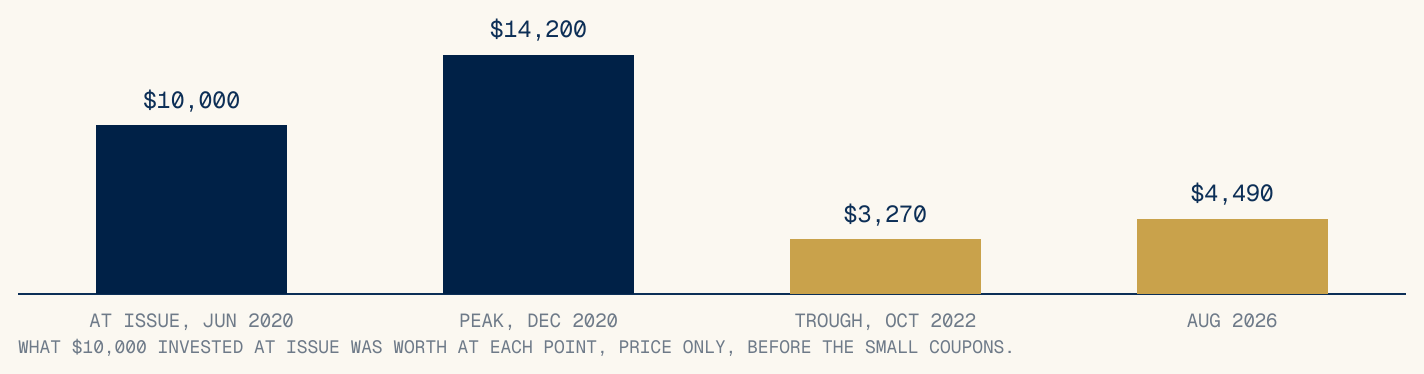
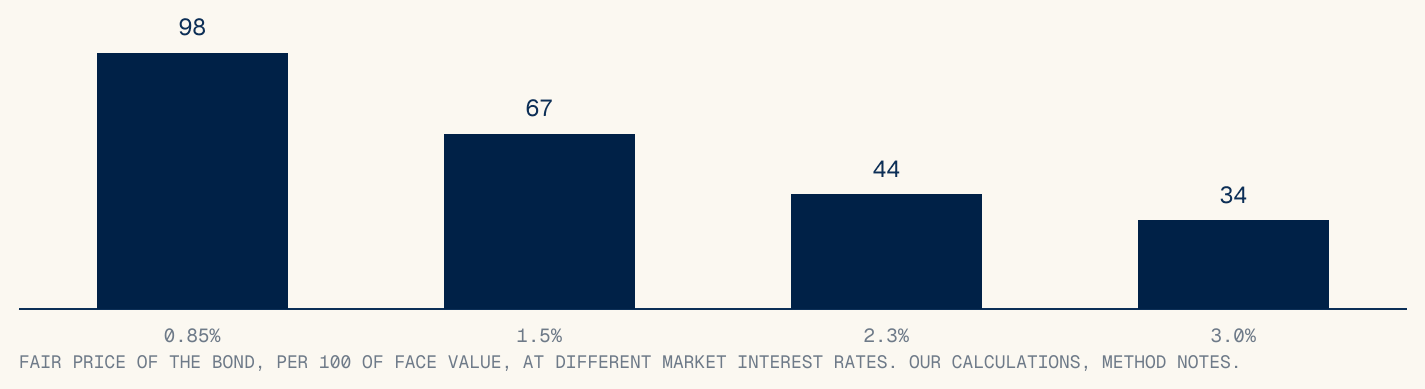
The size of the move follows from the arithmetic of fixed payments. A bond promising 0.85 per cent for a century is worth its face value while market rates sit near 0.85 per cent. Once the market rate for long loans reached about 3 per cent in late 2022, a buyer could only be attracted to this bond at a deep discount, and the fair price worked out to about 32 per 100. At the August 2026 market rate of roughly 2.3 per cent, the fair price is about 44. Our own present value calculations reproduce each of the sourced prices within rounding, which is the check that this story is arithmetic and not opinion.6
Section 03
Duration, the number that would have warned you.
Plain English · duration, the number
Duration measures how sensitive a bond’s price is to interest rates. As a rule of thumb, a duration of 5 years means the price falls about 5 per cent if rates rise 1 percentage point. This bond’s duration at issue was about 67 years, which is why a modest looking rise in rates removed most of its value.
Duration is published for every bond fund and every index, monthly, for free. The table below puts the Austrian bond on the same scale as the instruments Australians actually hold, from a term deposit at the bank through to the index inside a balanced super option.
| Instrument | Duration, years | Approximate price move if rates rise 1% |
|---|---|---|
| Bank term deposit, held to maturity | 0 | None. The balance does not reprice. |
| AusBond Composite index (most super defensive sleeves) | ~5 | About -5% |
| Australian Government bond, 10 year | ~8 | About -8% |
| Austria 0.85% of 2120, at issue | ~67 | -45% on a full recalculation6 |
| First registered mortgage, 12 month term, held to term | ~1 | No market price to move; the loan repays at face value. The risk sits elsewhere, in Section 04. |
Section 04
The Australian version.
Very few Australians own Austrian century bonds. Millions own the AusBond Composite, mostly without knowing its name, because it is the standard fixed income holding inside balanced super options. Through the 2010s, governments and companies sensibly locked in low rates for longer, and each long bond that entered the index nudged its duration higher. By 2021 the index carried close to six years of duration and yielded barely 1 per cent, so when rates rose about 3 percentage points across 2021 and 2022, the index fell in line with the arithmetic above.5
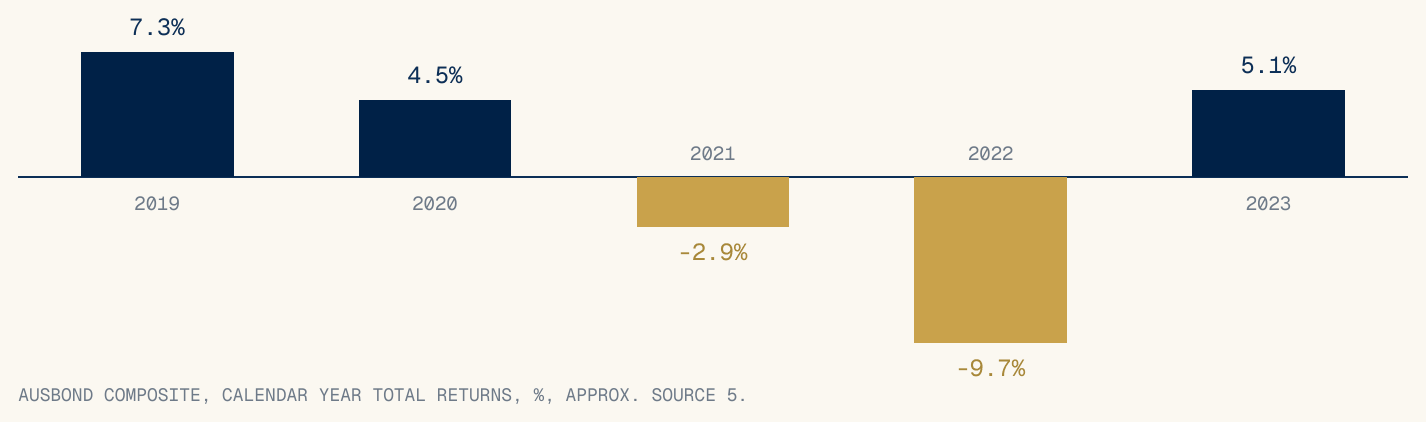
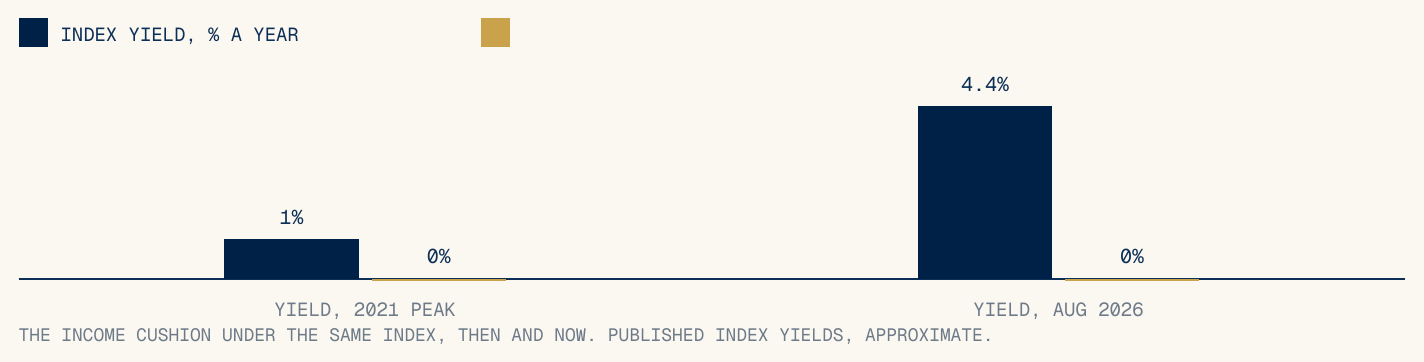
Both bars matter. The 2022 result was the ordinary behaviour of a five to six year duration asset when rates rise sharply from a very low base. The 2026 position is genuinely healthier: an investor buying the index today is paid roughly 4.4 per cent a year while holding it, and that income offsets moderate rate rises. The purpose of this section is not to warn anyone off bonds. It is to put a number on a risk that usually travels without one.
Section 05
Two different risks, one word.
People use the word risk for two separate things in lending, and this paper’s whole argument is that they should be kept apart and priced apart.
| Repayment risk | Repricing risk | |
|---|---|---|
| The question | Will I get my money back? | What is my investment worth if I need to sell before maturity? |
| The Austrian bond | Very low. AA+ government, perfect record. | Extreme. 94 years of fixed payments, priced daily. |
| A 12 month first mortgage, held to term | Real, and carried deliberately. The borrower may default. | Minimal by construction. Short term, repaid at face value, no daily market price. |
| Main protection | First registered security at 65 to 70% of an independent valuation | Time. The shorter the term, the less the world can change. |
A first mortgage written for twelve months at 65 to 70 cents against each dollar of independently valued property, and held until it repays, carries almost none of the risk that hurt the Austrian lenders. The lender receives interest and the face value if the borrower performs, whatever bond markets did in the meantime. In exchange, the lender accepts concentrated repayment risk, and gives up three things that deserve to be stated in full rather than skipped.
| What the mortgage gives up | Why it matters |
|---|---|
| Liquidity | The Austrian bond can be sold this afternoon, at the market price. A mortgage cannot be sold quickly, and an investor should only fund one with money they can commit for the term. |
| Government credit quality | European sovereigns pay. Property borrowers sometimes fail to, which is the entire reason the loan is written against registered security at a discount to valuation. |
| A visible price | No daily price means less information, and the smoothness of an unlisted fund’s returns partly reflects the absence of marking. Our Paper 09 covers this at length rather than in a footnote. |
Both structures are legitimate. A sensible portfolio can hold either or both. Our test is the same for each: the holder should be able to name which of the two risks they are carrying, and in what size.
Section 06
Three questions for anything labelled defensive.
The practical output of this paper is a short checklist, and it applies to our fund as much as to any bond holding.
| Question | Where to find the answer | What a good answer sounds like |
|---|---|---|
| What is its duration, in years? | Every bond fund and index publishes it monthly. | A number. If nobody can produce one, that is also an answer. |
| What does it return if held to maturity, and can I actually hold it that long? | The yield to maturity, against your own need for the money. | Almost nobody can hold a 2120 bond to 2120, so for that bond the market price is the reality. A 12 month loan is short enough to genuinely hold. |
| Which risk is the yield paying me for? | The fund’s own documents, if they are honest. | A government bond’s yield pays for repricing risk. A mortgage rate pays for repayment risk, illiquidity and work. If the yield looks generous for the named risk, look for the unnamed one. |
Austria will almost certainly repay its bond at full face value on 30 June 2120, and everyone who lent will eventually have been repaid exactly as promised. The lesson of the ninety-four years in between is that the promise and the price are two different things, and the defensive part of a portfolio is exactly the place where an investor should know, in years and in dollars, which one they own.
Sources and method.
- Republic of Austria, OeBFA issuance data. RAGB 0.85% due 30 June 2120, ISIN AT0000A2HLC4, syndicated June 2020, reoffer price near 98.
- Bloomberg reporting, 2022 and 2023: the bond 55 per cent below its late 2020 peak by March 2022; reopened to approximately EUR 4.6 billion outstanding.
- Contemporaneous market reporting of the October 2022 trough in the low 30s per 100.
- Exchange market data, August 2026: price approximately EUR 44 per 100, yield approximately 2.3 per cent.
- Bloomberg AusBond Composite 0+ Yr Index: peak to trough fall of 12.7 per cent across 2021 to 2022; calendar year figures as charted are approximate; index yields as published.
- Oxford Capital calculations, method below.
Method notes.
Bond prices are standard present value calculations on an annual coupon of 0.85 per 100: 98.0 at a 0.88 per cent yield over 100 years; 67 at 1.5 per cent; 44 at 2.3 per cent over 94 years; 34 at 3.0 per cent. These reproduce the sourced market prices within rounding. Duration at issue is 67 years modified (Macaulay 67.4); the minus 45 per cent figure for a 1 percentage point rise is a full revaluation from issue conditions rather than the linear rule of thumb, which overstates moves of this size. Figure 2 converts prices per 100 into dollars on a $10,000 purchase at the issue price and excludes coupon income, which over the period totals roughly 5 per cent of the purchase amount. The AusBond duration and yield figures are from published index characteristics and are approximate. Figures may not sum exactly due to rounding.
Disclosure.
This paper is issued by Oxford Capital Pty Ltd (ACN 700 065 872). Oxford Capital Pty Ltd is the investment manager of the fund and a corporate authorised representative (CAR No. 1323556) of Non Correlated Advisors Pty Ltd ACN 158 314 982, AFSL 430126. It does not hold an Australian Financial Services Licence of its own. The trustee of the fund, and the issuer of units in it, is Non Correlated Capital Pty Ltd ABN 99 143 882 562, AFSL 499882. This document is general information and commentary only. It is not financial product advice, does not take into account any person’s objectives, financial situation or needs, and is not an offer or invitation to acquire any financial product. Any interest in a fund managed by Oxford Capital will be offered only to wholesale or sophisticated investors within the meaning of the Corporations Act 2001 (Cth). Oxford Capital is a lender against Australian property and has an interest in investors considering private credit; readers should weigh this paper accordingly. Figures are drawn from third party sources believed reliable but not independently audited. Past performance is not an indicator of future performance. Nothing here is a statement that any investment is safe or that capital is protected.
OC-RP-01 · August 2026 · Second edition